
Teaching Phonics with Flashcards
These phonics flashcards for kids are designed for more than just quick drills. This guide will show you how to use the unique, image-rich design of your cards to build a strong foundation in decoding, blending, and reading confidence.
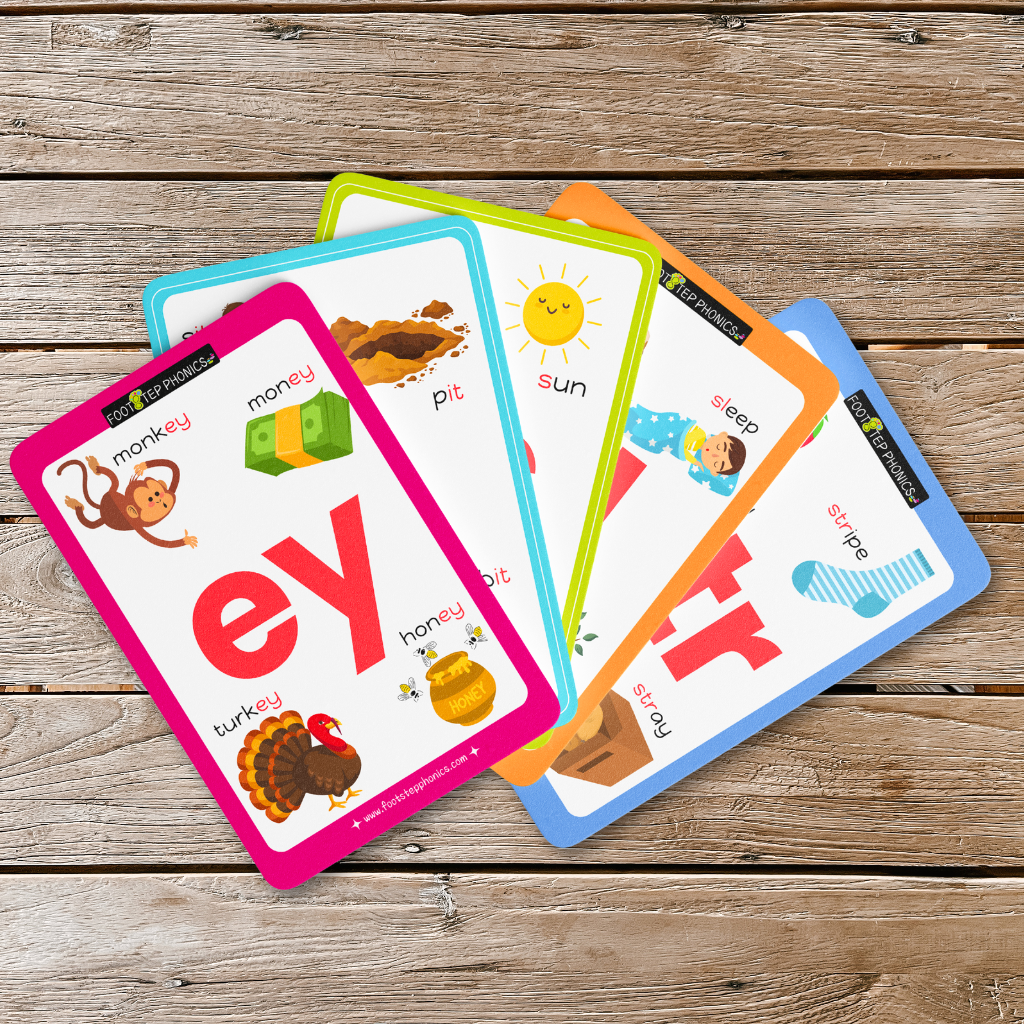
Why Our Flashcards Work: The Science of Learning
Our phonics flashcards are engineered using cognitive science principles to help skills move from short-term to long-term memory.
✴
Dual-Coding Theory
Each card pairs clear letters or graphemes with a simple, memorable image. This links the visual and verbal pathways in the brain for stronger recall.
✴
Active Recall & Spaced Repetition
The physical act of flipping cards promotes active recall—proving what you know—which is far more effective than passive review. Our suggested game schedules naturally encourage spaced repetition, the key to mastery.
✴
Focused & Frictionless
Unlike screens, our tactile cards eliminate distraction and are purpose-built for one thing: building automaticity in phonics skills.
How to use your flashcards:
Phonics games
Strategic phonics games are excellent for review and making learning joyful.

✴
Sound Safari
Scatter cards image-side up. Say a sound (e.g., /m/). Students race to find the card featuring a mouse or a monkey.

✴
Relay Race Decode
The first 2 players run to a card on the wall. They each read the sound and one word on the card, run back and tag the next 2 players.

✴
Sentence Builder
Challenge advanced learners to use a word from the flashcard in a spoken sentence to build vocabulary and comprehension.
Building Skills Step-by-Step with Your Flashcards
Sound & Picture Matching
Focus on the central sound and one picture. Ensure your child can consistently match the sound to the correct image (e.g., hears /m/, points to the “moon” picture).
Guided Blending Practice
Use the printed word next to an image. Model how to point to each letter, say its sound, and blend them together to read the word. The picture provides immediate confirmation.
Mastering Digraphs
Your digraph flashcards (sh, ch, th) provide perfect built-in context. For the “sh” card, practice all four words (e.g., ship, fish, shell, shoe). This repetition from different word positions (beginning, middle, end) cements the digraph concept.
Independent Decoding
Cover the pictures and use only the four printed words for practice. Ask, “Which word says ‘brush’?” Then, reveal the image to self-check. Discuss the meaning of any new vocabulary found on the cards.
Our Card Design Benefits Both Student and Teacher

1
Integrated Learning:
The combination of a central sound, images, and printed words on one card allows you to teach sound recognition, vocabulary, and decoding seamlessly.
2
Built-in Context & Extension:
Four examples per sound provide immediate practice and variation, preventing rote memorisation and teaching words in context.
3
Designed for Clarity:
The organised layout visually teaches children that sounds connect to meanings and specific spellings, building a solid mental model for reading.
Ready to begin? Use the central sound as your anchor, use the images to build meaning, and use the words to teach decoding. Keep sessions short and positive, and watch your child discover the code of reading. For more playful review ideas, explore our collection of phonics games in your lesson plans.
Frequently Asked
Addressing your common concerns
“My child guesses words based on the first letter.”
Cover the picture and have them sound out the word first, then reveal the picture to check their answer. This reinforces that reading is about decoding sounds, not guessing.
“We keep practising, but progress is slow.”
Celebrate small wins! Mastery of a single short vowel sound is a huge step. Consistency over time is key.
“My child knows the sounds in isolation but can’t blend them.”
Try “continuous blending.” Say the sounds without stopping: “ssssaaaat” instead of “/s/ /a/ /t/.” Use your finger to draw a line under the cards as you stretch the sounds together.
“My child is easily frustrated and doesn’t want to practice. What can I do?”
Shorten sessions. Aim for 3-5 minutes of joyful practice instead of a longer struggle. End while they are still having fun.
Ready for a solution that does more?
Get the complete FootStep Phonics Program